
When security and performance can never be compromised, why don’t you invest your time to understand what it takes to find the right blockchain service provider?
You not only need a blockchain development company, but you also need a partner who values your business goals. Faster operations, security, transparency, and cost cuts are all the benefits you need to enjoy, but a weaker smart contract or poor security architecture can cost you more.
So, the decision-making process can become complicated. To help you with this, we have decoded the process by considering the minute details.
What is A Blockchain For Businesses?
We would like to take you through a quick gist on what blockchain is and what it is not. There are several misconceptions about blockchains, leading to hesitation among business owners.
Blockchain was not created for bitcoin or cryptocurrencies. The idea of a blockchain-like protocol was first proposed by David Chaum in 1982, with the motive to make different organizations (that don’t trust each other) work together, without centralized systems.
For the effective running of supply chains, implementing blockchain technology can help you and your partners to work together in a harmonious way, even when trust is weaker.
The second most vital factor every leader knows before integrating blockchain into operations is that the technology is vulnerable to hacks. A poorly written smart contract, weak key management, or insecure APIs can lead to compromise of the systems.
And finally, many businesses may consider that blockchains are too expensive. While the technology requires initial investment for implementation, it can reduce the many mundane manual verification processes, paperwork, and increase the efficiency of the system.
Benefits of Blockchain
- It makes the process transparent to all the authorized parties.
- Any asset or product can be easily tracked throughout the lifecycle.
- The recorded information is tamper-resistant, and thus increases the confidence among stakeholders.
- Helps in reducing duplicate records.
- Supports scalability for business models.
How Industries Are Adopting Blockchain in 2026?
Food, manufacturing, fintech, health, and even government sectors have started to implement blockchain for their internal processes.
Finance was the first industry to adopt blockchain at scale, as the technology was developed to enable decentralized digital transactions of cryptocurrencies. It took nearly a decade for the system to mature and to get deployed for mainstream adoption seamlessly.
According to Deloitte’s 2021 Global Blockchain Survey, 81% of financial services leaders believe blockchain technology is broadly scalable and has already achieved mainstream adoption. In the same survey, it was mentioned that 76% believed that physical money would become obsolete in the next 5-10 years.
Proliferation of blockchain tech didn’t just stop with the fintech industry. It was then deployed in food & agriculture for farm-to-fork traceability and supply chain & logistics. There were many notable government initiatives across the globe to make use of blockchain tech.
The Digital Dubai Office and the Dubai Future Foundation have collaborated to initiate the Dubai Blockchain Strategy. Launched by His Highness Sheikh Hamdan, the government-led initiative focuses on three pillars: government efficiency, industry creation, and international leadership. It is estimated that this initiative could help Dubai save AED 5.5 billion annually.
While there are many practical use cases and evidence for blockchain adoption, as a decision maker, you need to critically evaluate the operational challenges you are trying to solve before hiring a blockchain development company.
A 7-Step Methodology to Choose the Right Blockchain Development Company
From web3 startup founders to the key leaders of large enterprises can make use of the approach we have synthesized in their decision-making process. With our industry experience, we have analyzed the procurement frameworks and best practices for implementing blockchain to arrive at this solution.
Follow the guide to make the right business decision.
1. Define the Business Problem
The first and foremost step is to draft the business problem you are looking to solve using blockchain tech. This will help you to understand if blockchain is the right solution for your challenges or if it can be addressed by other means. Here are the practical problems that a blockchain might help you with. Check if you are facing any such problems.
- If you are a business entity working with multiple organizations that maintain their own records, blockchain can help by being a single digital ledger.
- If visibility is low for the end-to-end process, or you feel that the process is inefficient and consuming more time than necessary, introducing blockchain to the process can help you identify the SOPs that can be simplified. Not only this, you can easily track the progress as the technology can provide you with complete transparency.
- The smart contracts can help you reduce the burden of managing the paper-heavy workflows.
- If you are in the fintech sector, record tampering and cross-border transaction barriers can be completely reduced. Blockchain can significantly improve the transaction speed seamlessly.
The above-mentioned are some common issues that industries face. You can find the area that needs improvement in your operations, inventory management, supply chain or transaction rails.
2. Validate Whether Blockchain Is Appropriate
Once you’ve identified the business issues that need to be addressed, the next step is to justify if blockchain is the right solution for you. To complete this step ask yourself the following questions.
- How many independent organizations participate?
- Do suppliers, logistics providers, manufacturers, and retailers all maintain separate records?
- Are disputes about product origin common?
- Is end-to-end traceability required?
- Do regulators require a tamper-evident audit trail?
If a centralized database can achieve the same objective with lower complexity and cost, it may be the more appropriate solution. This consultative approach ensures that decisions are driven by business outcomes rather than hype.
You can brainstorm with your team to know the difficulties they face. This way can help you to conclude sooner.
3. Evaluate Technical Competence
Once you’ve identified the problems and decided to move with blockchain you need to start selecting the suitable blockchain development company. You need to know the technical capability of the design, build, deploy and maintain blockchain applications.
Explore their portfolio, understand their expertise in security audits, assess the integration capabilities and scalability options. Also, review their blockchain technology expertise. For this you can check their experience in smart contract developments, layer-2 scaling solutions, API and enterprise integrations. Thoroughly check if your business goals align with their expertise.
Inspecting their production-ready case studies, engineering practices, security standards, and the technical capabilities of the delivery team provides a clearer indication of whether the company can build a secure, scalable, and future-ready blockchain solution that aligns with long-term business objectives.
4. Assess Domain Expertise
Evaluating the technical competence can help you understand if they could build the blockchain solution for you. But assessing the domain expertise will let you know if they can solve your business problems.
This evaluation is crucial because if the blockchain development company doesn’t have the awareness about the industry’s workflows and operational challenges, even the best solution could fail. Industry-specific knowledge enables the development team to recommend the right blockchain architecture, anticipate compliance requirements, and design workflows that align with real-world business operations rather than generic technical assumptions.
Domain expertise is just as important as technical competence when selecting a blockchain development company. Reviewing industry specific case studies, consulting methodologies and outcomes of their past projects can give insight about their domain expertise.
Apart from the technical and domain expertise, crucially analyze if they have knowledge on the regulatory and compliance framework. Understanding the regulatory environment of different industries will help you to adhere to the best practices.
5. Verify Security and Compliance
Blockchain is meant to handle sensitive business information, financial assets and digital identities. Hence, security and compliance should be treated as core evaluation criteria rather than post-development considerations.
Check for their software architecture, and coding standards. Also, understand how the firm manages private keys, multi-factor authentication, and identity verification.
Before proceeding to the next step, enquire about the data that will remain off chain. Because not every piece of information would be stored in the blockchain.
Though blockchain are immutable and are highly secure, hacks and data leaks are inevitable. So ensure that the firm has a continuous security monitoring system and analyze their incident response procedures.
Security and compliance should be non-negotiable when selecting a blockchain development company. So you need to evaluate whether the company follows secure development practices, performs comprehensive smart contract audits, implements robust identity and access management controls, and understands the regulatory requirements specific to their industry.
6. Review Delivery and Support Capabilities
Almost all your checklists were covered in the steps we’ve seen so far. This is to know how the solution would be delivered and the consistent support they can provide you through the blockchain lifecycle.
This is the phase wherein you need to discuss with the blockchain service provider to know the project milestones. It is to fix the communication channels, sprint plans, and testing processes.
Also, evaluate the deployment guides, user manuals, and technical documentation. This is to keep a record on what is done so far and will help you to retrace what’s done so far and move forward further.
A blockchain implementation extends far beyond software development. This includes reviewing the company’s project management methodology, communication practices, testing procedures, documentation standards, and post-deployment support services. A partner with mature delivery systems can reduce implementation risks, improve project transparency, and ensure the blockchain solution remains secure, scalable, and aligned with evolving business requirements
7. Select the Partner That Provides the Strongest Long-Term Business Value
This is the final step in your decision making process. In this step evaluate the budget and the total cost of building, deploying and maintenance. You need to carry one of the most vital checks here. It is to understand if the blockchain development company values your vision.
Only when the business objectives are aligned the support system and long-term goals can be mutually achieved. And while evaluating the budget, carefully calculate the cost of operations and process efficiency you can achieve through the blockchain solution.
Apart from that, check the rooms available for continuous evaluation, and product enhancements.
Selecting the right blockchain development company should be viewed as a strategic business decision rather than a procurement exercise. Prioritize long-term business value over short-term cost savings.
Top 7 Blockchain Development Firms in 2026
To help further with your decision making process, we have compiled a list of blockchain development firms. We have done research and built the list based on their expertise, and industry experience. We have also considered their client portfolio, security practices, and customer reviews to know their credibility and market reputation.
1. ScienceSoft
ScienceSoft was founded in 1989 as an enterprise software development company that has expanded its expertise into blockchain later during 2020. The firm’s primary services include designing, developing and integrating software solutions for different industries such as financial services, healthcare, manufacturing, retail, logistics, and real estate.
Headquartered in Texas, they provide end-to-end blockchain services, including feasibility assessments, architecture design, smart contract development, tokenization, decentralized applications, blockchain integration, and security testing. ScienceSoft also demonstrates its emphasis on regulatory awareness and structured project delivery methodology.
In the three decades of their service they have successfully served 1500+ happy clients delivering 4300+ projects. Their clients mostly come from North America, Europe, the UK, and the Gulf region. They have a proven record projecting excellence in managing complex digital transformation initiatives across multiple industries.
2. Consensys
Ethereum co-founder Joseph Lubin, founded Consensys in 2014, with headquarters in Fort Worth, Texas. It was established specifically to accelerate the adoption of Ethereum and decentralized technologies.
Consensys is one of the widely recognized companies as it backs many popular products of the blockchain world. They are tabulated below.
| Product | Relationship with Consensys |
| MetaMask | Created and developed by Consensys |
| Infura | Acquired by Consensys in 2019 and now operated as a Consensys product |
| Linea | Developed and launched by Consensys as an Ethereum Layer-2 network |
| Besu | An open-source Ethereum client maintained by Consensys |
| Teku | An open-source Ethereum consensus client developed and maintained by Consensys |
In addition to its consulting services, Consensys has played a significant role in expanding the Ethereum ecosystem through its infrastructure and open-source initiatives. It is also an active participant in developer conferences, technical workshops, hackathons, and community events.
3. LeewayHertz
Founded in 2007, LeewayHertz is a technology consulting and software development company with headquarters in San Francisco, California. Initially they started by providing enterprise mobile applications. As the need for the technology grew, they expanded its capabilities into emerging technologies such as blockchain, artificial intelligence (AI), the Internet of Things (IoT), and cloud computing.
Over the years, it has worked with startups, enterprises, and more than 30 Fortune 500 companies across industries including manufacturing, healthcare, supply chain, finance, insurance, retail, and logistics.
LeewayHertz covers complete end-to-end blockchain development services including,
- Proof-of-concept (PoC) development
- Smart contract development
- Decentralized application (dApp) development
- Tokenization, blockchain integration
- Enterprise blockchain deployment
The blockchain development company has experience building solutions on multiple blockchain platforms, including Ethereum, Hyperledger Fabric, Corda, Hedera, Stellar, EOS, and other distributed ledger technologies.
4. PixelPlex
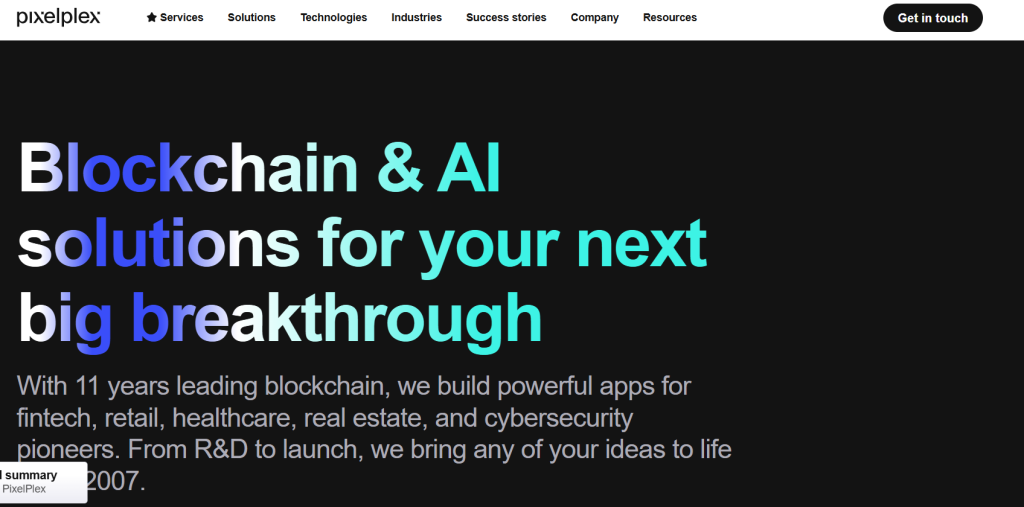
PixelPlex was founded in 2007 with headquarters in New York. It is a software development and technology consulting company specializing in blockchain, artificial intelligence (AI), the Internet of Things (IoT), and custom software development. So far the firm has completed 450 projects and has supported clients raising $1.2 billion.
Over the years the firm has helped startups, SMBs, Fortune 500 companies, and government organizations develop blockchain-powered digital products. Its expertise spans across industries including fintech, healthcare, supply chain, retail, real estate, gaming, media and cybersecurity.
5. ChainSafe
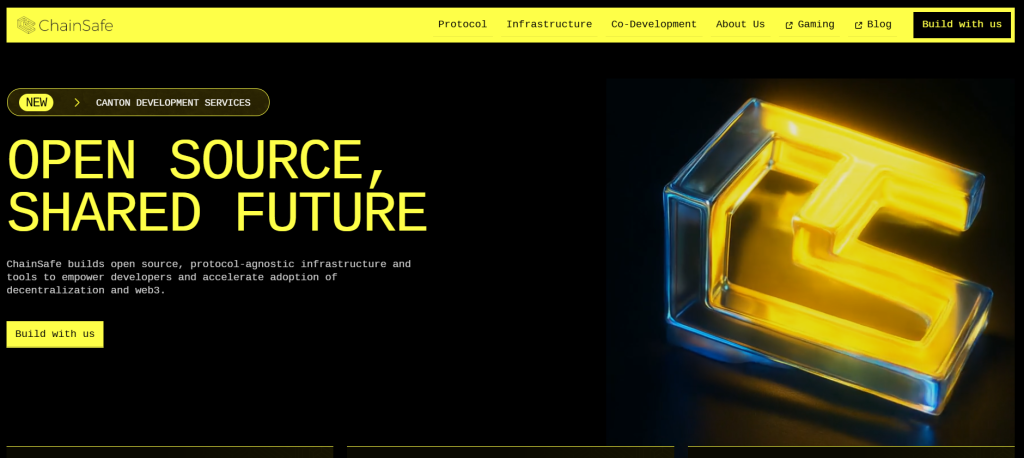
The founding story of ChainSafe is quite interesting. A group of blockchain developers who met at an Ethereum developer meetup in Toronto and shared a common vision of advancing decentralized technologies through open-source innovation. And ChainSafe emerged as their brainchild.
It was founded in 2017 and headquartered in Toronto, Canada. ChainSafe is primarily a blockchain research and development firm specializing in Web3 infrastructure, protocol engineering, and cross-chain interoperability.
Following its Series A funding round in 2022, the company grew its base with offices in Toronto, Berlin, and Zagreb. The open source nature of ChainSafe has made it a contributor to several major blockchain ecosystems including Ethereum, Polkadot, Filecoin, Optimism, and Canton Network.
6. Antier
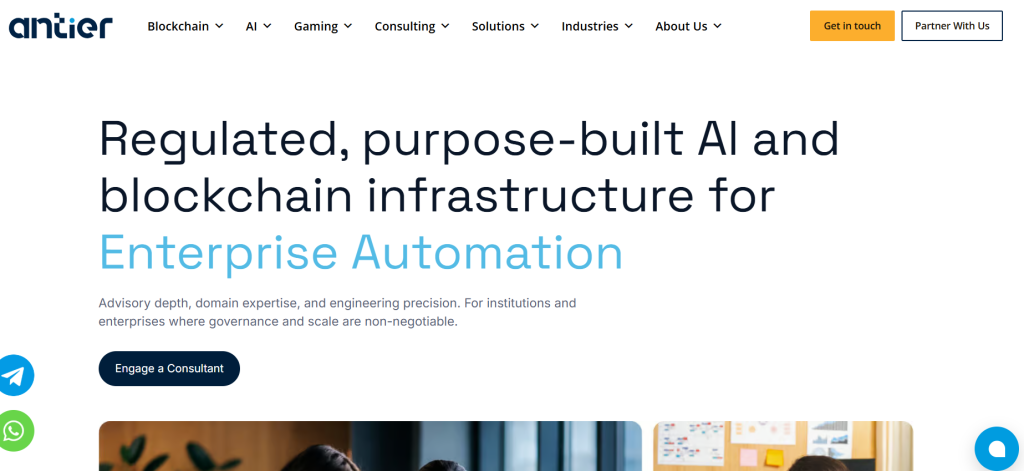
Antier is a blockchain and AI technology company headquartered in Mohali, India. It also has a global presence across North America, Europe, the Middle East, and Southeast Asia. Today, Antier employs more than 700 blockchain engineers, architects, and domain specialists and has delivered over 1,000 projects worldwide.
Its end-to-end blockchain services covers,
- Blockchain consulting
- Enterprise blockchain development
- Smart contract engineering
- Cryptocurrency exchange development
- Crypto wallet development
- Tokenization platforms
- Decentralized finance (DeFi) solutions
- NFT marketplaces
- Web3 infrastructure
It holds domain expertise in industries including banking, asset management, healthcare, insurance, logistics, telecommunications, and digital payments.
7. Blockchain App Factory
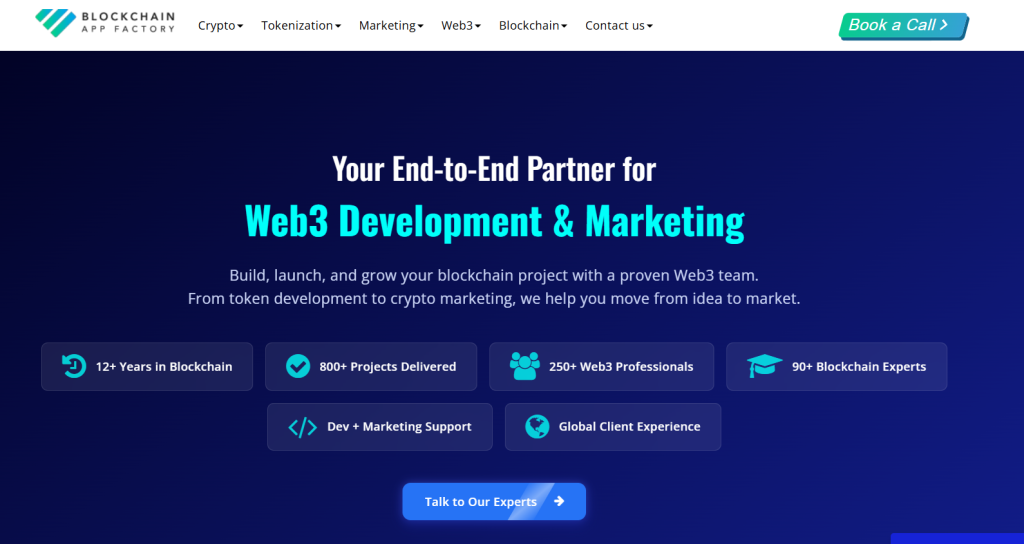
With a team of 250 Web3 professionals and 90+ blockchain specialists serving across multiple countries, Blockchain App Factory is headquartered in Chennai, India. Since its inception in 2013, it has delivered over 800 blockchain projects.
Beyond Web3 development and technology consulting, its service areas include blockchain engineering, digital asset infrastructure, and crypto marketing services. Over the past decade, the company has expanded from blockchain development into a full-service Web3 partner, supporting startups, enterprises, and Fortune 500 organizations.
It has a proven experience in delivering the following solutions.
- Smart contract development
- Cryptocurrency exchange development
- Tokenization
- Decentralized finance (DeFi) platforms
- NFT marketplaces
- Crypto wallets
- Layer-2 solutions
- Decentralized applications (dApps)
- Enterprise blockchain implementation
By providing a combo of technological solutions and Web3-focused marketing services, it manages both product development and commercialization.
To Wrap Up
Throughout the decades of developmental activities blockchain has evolved into unique solutions for businesses. According to a market analysis by Fortune Business Insights, the global blockchain technology market is projected to grow from USD 47.96 billion in 2026 to USD 577.36 billion by 2034, representing a compound annual growth rate (CAGR) of 36.5%.
As blockchain adoption continues to grow across industries, selecting the right development partner could be your gamechanger.
If you are struggling to choose the right partner for your business, experts at BlockWoods can guide you on it. We have over 5+ years of experience in sailing in the world of blockchain. Through our network and competitiveness, we could help you to put your efforts in the right direction.
FAQs
1. How much do hiring blockchain development companies cost?
The cost of hiring a blockchain development company depends on several factors, including the project’s complexity, blockchain platform, number of features, smart contract requirements, third-party integrations, security audits, and ongoing maintenance. A simple proof of concept (PoC) or minimum viable product (MVP) is generally less expensive than an enterprise-grade blockchain platform that supports thousands of users and integrates with existing business systems.
2. What services do blockchain development companies offer?
Generally blockchain development companies offer consulting, smart contract development, tokenization, proof of concept development, web3 infrastructure development and more such services. Many companies also provide tokenization services, cryptocurrency wallet development, enterprise blockchain implementation, blockchain infrastructure setup, API integration, maintenance, performance optimization, and post-deployment support.
3. How long does blockchain development take?
There is no fixed timeline for blockchain development because every project has different technical and business requirements. A proof of concept or MVP can often be completed within a few months, while enterprise blockchain solutions involving from smart contracts development to user testing may take considerably longer.
4. What should I look for in a -blockchain development company?
When selecting a blockchain development company, businesses should evaluate more than technical expertise. Consider whether the company understands your industry, has experience delivering similar blockchain projects, follows secure software development practices, performs smart contract audits, and offers long-term maintenance and support. This was also detailed in the blog article above.
5. Do blockchain development companies provide post-deployment support?
Yes. Most blockchain development companies offer post-deployment support to ensure that blockchain applications remain secure, reliable, and up to date after they go live.